Commercial & Office Movers in Asheville, NC
Asheville Movers relocates businesses across the Asheville area: offices, professional practices, shops and warehouses. A business move is built around your closed hours, with the equipment you trade on leaving last and arriving first. Office moves sit outside the household rules of the North Carolina Utilities Commission, so ask any provider how the job is documented. Share both addresses, headcount and your reopening date.
Types of business
Offices and professional firms
Law firms, accountants, advisers and consultancies.
Medical, dental and animal clinics
Clinics, where instruments and charts both need care.
Shops and storefronts
Shelving, inventory, displays and cash registers.
Warehouses and light industry
Racking, stock, workbenches and machinery.
Restaurants and commercial kitchens
Appliances, prep tables, shelving and stock, shifted around opening times instead of during them.
Schools, churches, clubs and charities
Classrooms, halls, offices and storerooms, commonly timed for a term break or a quiet stretch.
One team, a single floor or an internal move-around of staff
Emptying two floors, then refilling them after new carpet goes in.
Server closets, IT hardware and archive rooms
Done on their own or folded into a larger move.
Is it a house or apartment rather than an office? See residential moving, which is planned on a different basis.
Lost working time matters most
The truck is rarely where an office move costs you most. The real loss is every hour staff can't work, and that is the thing a commercial move gets scheduled around.
That calls for sequencing more than speed. Whatever you can't function without is identified first and moved last, keeping it offline as briefly as possible. IT tends to leave the old site last and arrive at the new one first. Anyone who can work remotely for a day goes early. A bigger firm may move in phases across several visits instead of one big push, which trades extra trips for less lost trading. Allow slack for winter dates too, since Asheville averages roughly 10 inches of snow a year.
None of this happens on its own on the day. It comes out of walking both buildings beforehand.
Decisions to make before moving day
Office moves that go wrong usually fail on the planning, not the carrying itself:
Have internet and phones switched on at the new address before moving day.
Getting a business line installed at a new address frequently takes much longer than anyone assumes, and it's the leading reason a firm completes its move yet cannot work on Monday. Order service the week you sign the lease, and press for a confirmed install date.
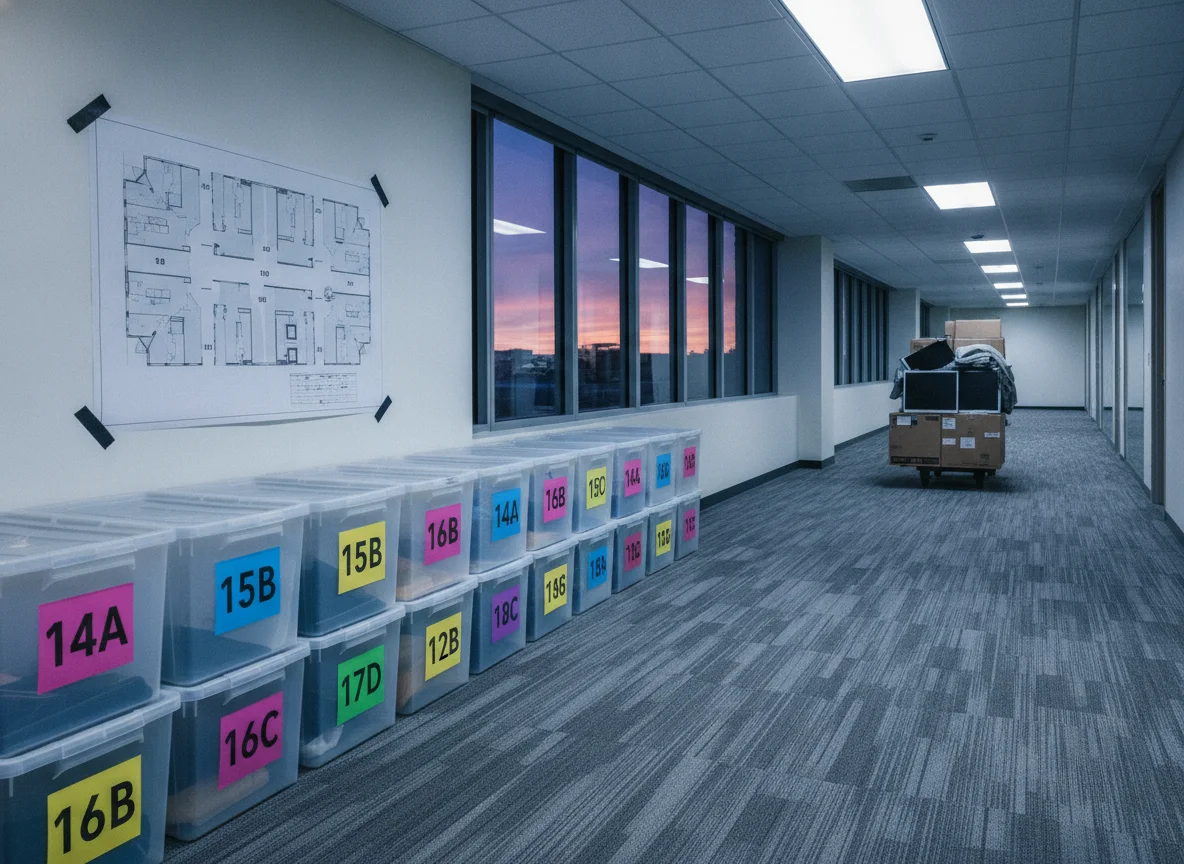
A numbered floor plan of the new space.
Label every desk, office and storage area so nobody is making decisions in a hallway while others wait around.
A labeling code everyone follows.
Give each destination room a number or color. Every carton and furniture piece wears it, and it matches the floor plan displayed at the new site.
One named contact at each address.
Someone on site who can answer questions and decide, at the old building and the new.
Employees pack their own desks.
Each person gets one crate marked with their name and new desk number; valuables and personal items go home with them. Staff find their belongings faster, and the whole job moves along.
Site access agreed in writing.
Who opens up, who locks up, alarm codes, keys, parking spots, and the hours the building allows work to happen.
Speak to both landlords early.
Property managers often want notice and paperwork from whoever is moving you before any work may begin. Ask what's needed long before the date, because it is hard to sort out in the final week before the move.
IT and equipment that come with conditions
Take a complete backup before unplugging anything.
Data loss is a real if small risk in any move, and a current backup turns it into a non-event for you.
Photograph the back of the rack and each workstation before starting
Shoot it before any cable is pulled. A few minutes with a phone saves an afternoon.
Cables come off in bags, labeled for the machine they serve
Never dumped into one carton. Monitors ride upright in purpose-built boxes; towers are boxed too.
Shutting down and restarting servers and network hardware is for your IT provider or a specialist
They power equipment off cleanly and restore it in the right sequence. Movers carry the hardware; configuring it is technical work, not moving work, and shouldn't be treated as such.
Check the lease terms on copiers and multifunction printers before moving one.
Many leasing firms insist their own technician relocates the machine, so shifting it yourself might breach the contract or void support cover. Book that separately and early.
Safes, fire-rated cabinets and big machinery
They need proper equipment and enough people, and sometimes a check on what weight the new floor is rated for. Raise them at the start.
Medical, dental, lab, kitchen or fitness equipment made for a trade
Often comes with a manufacturer or vendor rule about disconnecting, transporting and recalibrating it. Where one applies, that task belongs with the vendor and not with the movers.
Workstation and furniture systems
Cubicle and partition systems can be taken apart and rebuilt, yet they aren't interchangeable: panels, connectors and hardware match one system only, and the old layout may not suit the new floor plan. Work out what you own and what the new space will take before assuming it all transfers, and photograph the current layout first.
Height-adjustable desks, boardroom tables, filing units and racking can also be dismantled and rebuilt. Keep every fitting bagged and tied to its own piece, because a partition missing its connectors is scrap metal.
Confidential files and records
Client files, staff records and medical or financial paperwork should be sealed, numbered and tracked at each end, with nothing left alone and no unexplained arrivals. Where regulations apply to your records, raise them during planning and ask the provider how it will comply, rather than on the day itself, when it is too late to change anything.
Anything that shouldn't leave the building at all must ride along with one of your own people.
Handing back the old premises properly
Many commercial leases expect the space returned in a stated condition, which gets forgotten until the final week. Bolted shelving, wall brackets, signage and cabling normally need removing, and what's left needs a destination. Retired furniture, dead IT equipment and archives staying behind each require a disposal plan of their own, with a date.
Flag it early. With notice it's easy, but late in the game it gets expensive quickly.
What drives the price
Volume, how much must be taken apart and rebuilt, the amount of IT and specialist equipment, how hard each building is to load, whether the job needs one visit or several, whether it runs inside or outside your hours, and how much old space must be cleared. Downtown, a truck space needs a closure request to City of Asheville Parking Services with at least 72 hours' notice. If you'd rather handle some in-house, loading and unloading help covers the lifting.
Work reaches Asheville proper, from West Asheville and Montford Hills out toward Woodfin, Swannanoa, Fletcher, Canton and neighboring towns.
Quick answers
Can we stay open throughout?
Often, yes. Phased moves and moves timed around your hours exist so a business doesn't have to close. Expect more planning and possibly extra trips, which most firms find worth the effort.
Who unplugs the computers?
Your IT provider or a specialist handles the shutdown, the network and the restart, while the movers deal with the physical hardware. Agree on who does which well before the day, because a mix-up over that assumption can cost an entire morning of work.
How early should planning start?
Earlier than a home move, and the truck isn't what sets the timetable. Connectivity, landlord paperwork and vendor-handled equipment do, and their lead times sit outside your control, so begin once the new address is final.
Can packing be part of it?
Yes, via packing services, covering all of it or only what you'd rather not hand staff, such as a records room or kitchen. Many firms ask employees to box their own desks and hand over the remainder.
Ready to plan the move?
Send both addresses, the number of people and workstations moving, your target date, and any special items on site: servers, a safe, medical or lab equipment, a leased copier. A visit to both buildings turns all that into a workable plan.