Packing Services in Asheville, NC
Asheville Movers packs homes and businesses across the Asheville area, from every room down to only the ones you dread opening. Boxes get labeled by destination room, and unpacking at the new place can be added on. Send over the rooms you want handled and your moving date, and ask what packing materials come with the job, since that varies.
How much of the work you pass along
Many people assume packing help is all or nothing. There are really four versions, and plenty of households blend two or three of them:
Whole house.
Every room, closet and drawer gets boxed. Set aside only what you'll need on your last night and first morning, and the rest is taken care of.
Selected rooms.
Only the rooms you'd rather skip. Kitchens lead the list by a wide margin, then garages, china cabinets and home offices; the remainder is yours to pace as you like.
Breakables only.
Glassware, china, crystal, mirrors, framed art, TVs, instruments and collections are packed with care, and you take on the clothes, books and linens, which are the simpler jobs.
Unpacking.
The service hardly anyone books, yet many wish they had afterward. Details come below.
Prefer to pack everything yourself? Ask about materials anyway, because the proper carton for each item does most of the work, and improvised boxes are where people go wrong most often.
Packing happens before moving day
Think about your calendar first. A full pack takes place ahead of the move, often the day before, or over two to three days in a large house, so the truck arrives at a home that's boxed already. For what happens on moving day, see the local moving and residential moving pages.
That reshapes your final days. Bedding, the coffee maker, toiletries and pet supplies go in last, sometimes on the morning of the move. Whatever you're still using stays out and gets its own box at the end. Sorting also has to finish before packers show up, because they box whatever sits in front of them, even the junk drawer and the closet of clothes you've already decided to donate or sell.
What careful packing looks like
Most breakage comes from method, not misfortune. Here is what separates a well-packed carton from a poor one:
Plates go in vertically, never lying flat
A flat stack puts the weight of the whole pile on the middle of the bottom plate, which is exactly where the cracks start, usually on the way out.
Plain paper rather than newsprint.
Newspaper ink smears onto china, glass and anything painted, and scrubbing it off becomes a chore.
Each box full to the lid, with no hollow pockets left
Hollow cartons cave in under the next box, whereas a snug one bears weight. After sealing, tip it slightly; the contents shouldn't shift at all.
Dense items in small boxes, airy ones in large
A big box of books tends to split along the bottom seam, often halfway down a staircase on the way out of the house.
Seams on the base sealed across and along both sides
One thin strip is wishful thinking.
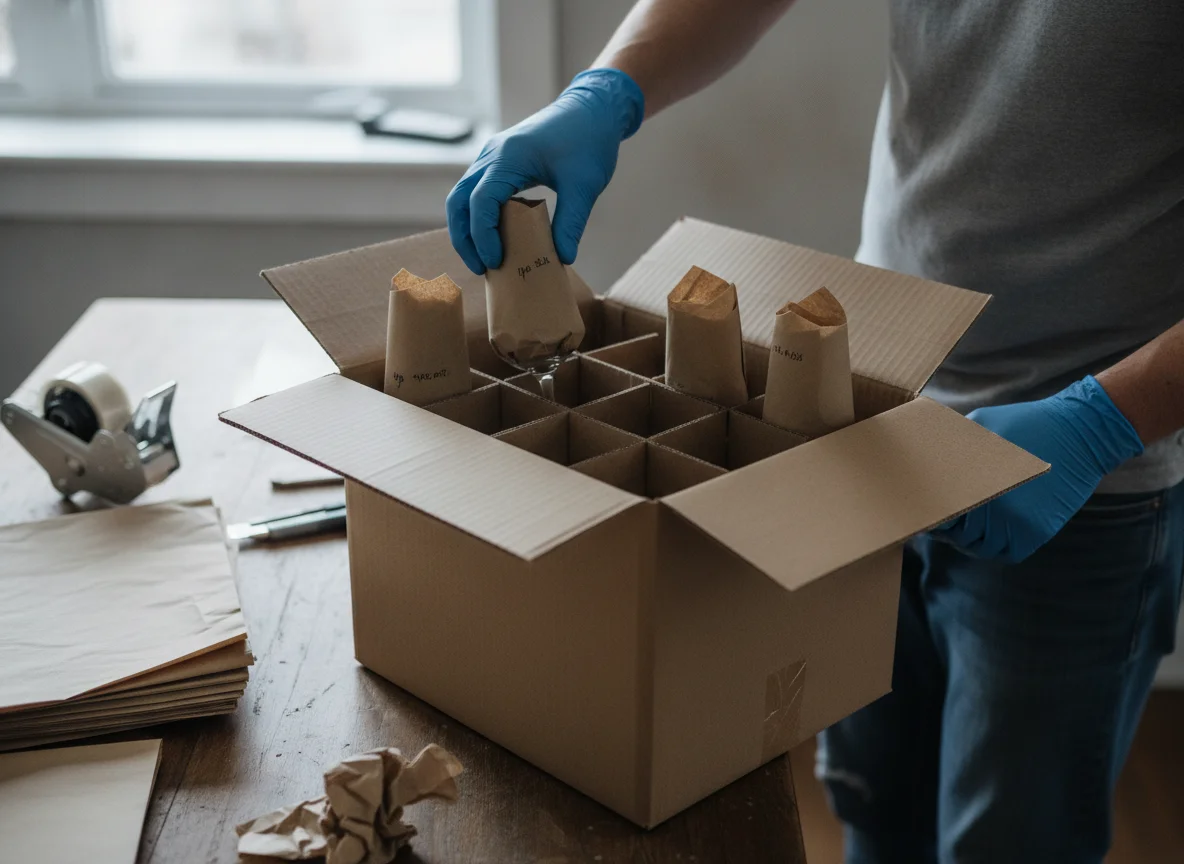
Wine glasses upright in dividers
One glass to a cell keeps them from touching.
Lampshades kept separate
Nested together, never boxed with a base or under anything heavy. Crushed shades are the commonest avoidable casualty of a household move.
Mirrors, framed art and glass tops in telescoping boxes
Always carried and loaded on edge.
Each box labeled by destination room, with an up arrow and a summary of what's inside
Plus a note of anything sealed without being checked.
What stays unpacked
Hazardous items: flammable, pressurized, corrosive.
Gasoline, propane, paint thinner, solvents, aerosols, pool and yard chemicals, ammunition and fireworks. Nothing like this belongs in a box on a truck, so use it up, dispose of it properly, or transport it yourself beforehand.
Food that spoils, and opened food
This is why the fridge and pantry are cleared out, not packed.
Key papers, prescriptions, jewelry, keys, laptops, hard drives and irreplaceable things
They ride with you. Packers are normally told to leave such items alone instead of guessing what matters most.
Houseplants and pets
Neither rides safely in a box. Plants dislike cold trucks, since Asheville's average January low sits around 29 degrees F; a pet needs its own plan too.
Anything you'd prefer others not touch.
Tell them, put it all in one room and shut the door.
Unpacking, the part many people forgo
Booking the pack but not the unpack is the typical false saving. Packing is squeezed in before a deadline, whereas unpacking stretches across months, with cartons crowding the hallway, the garage and the spare room in the meantime.
An unpack opens boxes one room at a time, places contents on surfaces or into the cabinets you choose and, the step that matters most, clears the packing material away. A move leaves behind a surprisingly stubborn pile of flat cardboard and crumpled paper, and recycling a whole house's worth is a real errand, so ask whether hauling it off is included, and when.
As with packing, it can be sized to fit: the entire house, or just enough to get the kitchen and bedrooms running by the first night.
Purge before packing
Someone is about to wrap, box, carry and unwrap every object you own, including those you meant to discard. Deciding what stays behind is the best-paid afternoon of any move, and for a long-distance move, where shipment weight drives the bill, even more so. Do it first: once an item is taped inside a carton, nobody reopens it, so the choice gets made by default and you pay to move and unpack things you never wanted to keep.
What drives the price
Room count, how much is fragile, and which specialist supplies the job calls for, such as dish packs, wardrobe boxes, mirror cartons, or custom crates for art and stone. Add whether unpacking is part of it, and how much sorting remains when the packers walk in.
One more factor has nothing to do with price. Who sealed a box affects who is responsible if something inside arrives broken, and the gap is wider than most people think. In-state household movers must carry a minimum level of cargo insurance set by the North Carolina Utilities Commission; ask how packed boxes are treated before dividing the rooms.
Work reaches Asheville proper, from West Asheville and Montford Hills out toward Woodfin, Swannanoa, Fletcher, Canton and neighboring towns.
Quick answers
Are boxes and supplies included?
Ask when booking. Cartons, plain paper, tape and specialist boxes are normally part of a packing job, but what is supplied differs from one provider to the next, and checking early is simpler than assuming.
Can I pack a few rooms and you take the rest?
This is the most typical setup. Say which rooms you're taking and which you're leaving, and mark your own boxes clearly so nothing is packed twice or missed.
Should I stay while packing happens?
Yes, at least at the start and finish. Small decisions keep coming up, like what stays, what rides in your car and which cupboard is off limits, and they're easy in person. The North Carolina Department of Justice also advises keeping a written inventory.
What happens to all of the cardboard?
If unpacking is part of your booking, ask whether the cartons leave with the packers. If you unpack alone, plan ahead: a whole house of flattened boxes exceeds normal pickup, and arranging disposal early beats facing the pile.
Ready to pass off the packing?
Tell us the rooms to pack, the number of bedrooms, the date you're moving and whether you'd like help unpacking at the destination. Moving a business instead of a home? Commercial moving explains the usual split between your own staff and the movers.